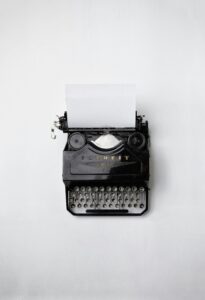
Photo by Florian Klauer on Unsplash
My Process
There is an approach to writing that says all a writer needs to do to write a story is sit at a keyboard, or page with pen in hand, and begin to happily imagine an interesting story. Like day dreaming. This is delusional.
Getting started
I have found that the story seems to grow, coalesce or precipitate out of a solution of background information that I have collected in a vomit document. The vomit document is just a document wherein you vomit all that you know about your story: timeline, setting, characters, plot points, even dialogue snippets, names, any detail no matter how random. (I first heard of a vomit document in a webinar presented by the screenwriter, Stephen Desmond, who might have used the phrase “sandbox” instead of vomit document. He uses the Save the Cat method for screenplays.) I like to call it vomit document. My vomit document is ongoing, and morphs into a story bible.
After doing a comprehensive vomit document, my planning stage consists of doing a ZERO DRAFT. I first heard about this on Shaelin Writes YouTube channel. She mentions the zero draft as a way to pre-plan your novel if you don’t like to outline. She talks about this as a way of fast drafting. For me, it’s not fast, but it’s sketching to get the scenes out; leaving placeholders, not taking time out to do more research but just plowing ahead.
Side note: For fiction writing that’s not sci-fi or historical fiction, you don’t need to do as much research. If you are dealing with a setting that’s unfamiliar, or characters with backgrounds much different to your own, or plot elements that might contain some specific technical, cultural or scientific information, then obviously you need to do some research.
I came up with a concept for a novel in 2019. I knew what the theme would be. I knew who some of the characters were. It took me years to actually get to a place where I was seriously planning the book. I started as an outliner because trying to be a pantser left me staring at blank page in a cold sweat.
Once I decided to outline, I used Save the Cat Writes a Novel outlining method, and How to Write a Novel Using the Snowflake Method. I only got so far using these methods, but I did unearth plot elements and character information.
Another side note: Explore genre. I read John Truby’s book, The Anatomy of Genres. I also read Romancing the Beat by Gwen Hayes, and 7 Figure Fiction by T. Taylor just to get a feel for what audiences want. I write to please myself, but it helps to know where your book fits into the publishing landscape.
Understanding genre helped me advance my plot. I first heard it advised to consider genre from Alan Moore in a snippet from his BBC Masterclass on YouTube. He explained that using genre conventions, or subverting them, can crack your story open in terms of plot by tapping into the energy of literature. I found this to be very true.
My work process is a hybrid: getting started via Save the Cat and Snowflake, moving to bubble diagram/maps for plot and character, and then to writing the zero draft.
The zero draft is fun because all pressure is off. It’s a zero draft, after all. For me, even if I tell myself I am only working on a first draft, I still feel pressure to make it cohesive, maybe stylistically coherent; that’s stifling for me. Telling myself it’s just a zero draft takes the pressure off. I can just do whatever then do a first draft to stitch it together, and start to make it into a coherent whole.
Here is a video by Mandi Lynn – Stone Ridge Books on You Tube, on making character maps. Her method shows the connectivity between the characters a crucial element of planning you characters. This method helped me enormously in planning my novel. Bubble diagrams are my favorite way to plan a plot as well. I prefer these visual aids that I create over written outlines or character lists. I gravitated to the bubble maps after going through an outlining process (in which I didn’t get very far because I don’t like to outline).