Karma Key (flash fiction)

The Foolish Secret


                 Karma Key


Sometimes it’s better to leave treasure buried.

That sharp, sparkling autumn day I sailed my 27-foot sloop, Foolish Secret, along the edge of a tangle of mangrove islets that line the coastline. Claiming a new terrain as my own undiscovered domain, I weighed anchor just offshore and dog paddled to a slender, white crescent beach that had been formed by the tides. The slip of beach was my own. It was accessible by way of the open Gulf, as I had come. From the mainland, in a canoe, you could follow the sun and eventually break out into the open water of an estuary or the shore of the Gulf. More likely you’d get lost, and wind up spending days and nights in a mosquito-infested mangrove swamp trying to find your way back to the mainland or out to the open water.

I waded through the tidal pool between the beach and the mangroves. I spotted what looked like the bow of a boat sticking out of the mud. The craft was obviously very old. The edges were worn, and the wood smoothed of any carvings or ornamentation. Could this be the wreck of a Spanish caravel forsaken on these shores half a millennia ago, and now exposed by the restless sea?

The only visible portion of the wreck was the bow sticking out of the anoxic muck. The rest of the boat was encased in the tangle of mangrove roots and silty mud. Through thigh-deep water I slogged until I reached the edge of the mangroves. I plunged into the forest. With each step I had to extricate my legs which sank knee-deep in the sucking mud floor of the forest.

I reached the wreck and ran my hand along the graceful lines of the oak bow sticking out from the ground about three feet. I realized that this could be a Spanish ship, since over the centuries countless vessels were shattered and lost—consumed by hurricane seas.

It was improbable that I would find a coin, but it couldn’t hurt to try. I dug into the muck with my bare hands. I felt a smooth rock. Using my fingers I dug it out of the sludge. It was a casket-shaped box encased in mud.

I went out from the mire into the clear water of the tidal pool and rinsed my find. A shadow came across the sand. As it passed I felt a chill in my shoulders and right into my spine. I looked up and a frigate bird was circling overhead. It’s sickle-shaped silhouette like a dark blade was sinister. The sky flattened to a metallic gray.

The muck clung to the box like pungent green-black clay. The rotting, vegetal smell of the mangrove forest sediment wasn’t unpleasant. It was the smell of primordial ooze from whence life emerged. The box was made of stone. Alabaster. It was like a small ossuary. The lid was seamlessly sealed to the base. Impossible to remove. Letters were carved on the lid. I scraped and rinsed off the mud. Like a stain the black silt that remained in the lines etched on the lid revealed the word—MORTEM.

The revelation of this word so startled me I actually jumped in my skin and dropped the box into the surf. Why would someone, centuries ago, carve this word, death, onto the top of this box? I retrieved the box from the frothing water and took it back up to the shore. I laid it on the ground, sat next to it, and stared at it until I fell asleep.

In my dream I am lying face down in the ooze of the mangrove forest. The black, viscous silt blocks my nostrils and mouth. Flashes of crimson light burst across my field of vision. As though it were a living entity devouring me alive I am subsumed into the sucking floor of the forest.

I woke with a start as wavelets of the cool Gulf water lapped at my legs which were by now half-submerged in the rising tide. Although she was still where I had weighed anchor, the Foolish Secret seemed further offshore. I grabbed my ossuary and swam back to the boat.

The sunset was bloodred and deep orange. The Gulf water turned crimson. A cloud of bioluminescence drifted ashore with the tide. It’s red coruscation echoed the sky. I was light-headed and dizzy. A strange weakness overcame my limbs. I went below deck to sleep it off.

Sleep did not come. I lay in my berth in the stuffy cabin listening to the water slosh against the hull.

I felt myself getting up from my berth. I looked through the jumble of tools in my toolbox for a hammer. I went back up to the deck.

The box was where I had left it. It was shining in the light from the moon that was setting in the western sky. The moon was a scarlet flower, and the box shone with a faint red glow.

I picked up the box and set it down on a blood-stained carving board I had on deck for cleaning fish. I raised the hammer above my head and brought it down on the the box which cracked open. Given the strength of my blow, I was surprised. Rather than shatter, the top of the casket separated into three clean pieces. A hissing, black mist emanated from within the casket. I was sickened by the overwhelming smell of rotting flesh. The mist, like a wet web of fungus covering decaying matter floated out and covered my face. I couldn’t breathe. I sunk to my knees and clawed and scratched my nose and mouth. All I could see was the glowing red moon, and bloody water. I felt the consciousness leaving my body through a portal at the top of my skull. I was no more. There was only the sea and sky. This, then, was what it felt like to die.

The End
Halcyon Days (flash fiction)

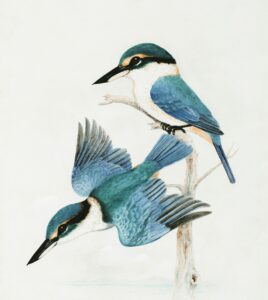
Photo by McGill Library on Unsplash

Halcyon Days

(A retelling of the tale, 〝Ceyx and Alcyon〞from Ovidߴs Metamorphoses)


If he hadn’t seen the island mirage, I wouldn’t be a bird now. Specifically, I wouldn’t be a halcyon bird. And neither would he.

Cai left me on the beach and set out for the island that appeared in the offshore mist that cold December day. As he waded into the shallows I screamed at him. Not screamed. Croaked. My voice was harsh, but almost inaudible. “No! Cai. I love you. Don’t leave me.” Like a bad soap opera, I kept repeating that I loved him. I clung to his arm. Maybe that would make him change his mind. He just laughed and shook me off. He grabbed his paddleboard and told me that he would come right back. “Or maybe I’ll stay overnight.”

I calmed myself and tried another tactic. If hysterical overreaction didn’t work, maybe reason would. “What are you looking for, Cai? It’s not there. The island isn’t real.”

In desperation to convince him not to try the crossing to the island, I said, “you’re just going to end up like your brother. Why? Why are you doing this?” All my histrionics might have seemed to have been an overreaction. After all, he was just going to paddle around the calm sound. The danger was not apparent. But I had had a dream the night before: In the cold, dark water, we were both searching for Dan. In my dream, we begin to struggle to stay afloat. I startled awake and took in a choking breath.

He came back to where I was standing in the sand. His eyes were so sad. “You think I want to end up like Dan?”

It wasn’t the first time we had seen the island. When the winds were perfectly still, as they were today, it sometimes preceded a sea fog. It looked like any other large spoil island—tall Australian pines lining a pristine white beach—only it hung above the surface of the water. It seemed to drift closer in to shore and then out again, as if it were being pulled to and fro by the rocking sea. I told Cai that it was an illusion, a Fata Morgana. But he didn’t listen. He was searching for something. Maybe oblivion.

Offshore, you could see the wall of sea fog that came up in the afternoon—after the sun had had just enough time to heat the air which, upon contact with the cold water, bloomed into a thick mist.

The danger of setting out on the water in these conditions didn’t seem to register with him. “It’s right there. I could swim if I wanted to.” “In fifty-degree water? Hypothermia anyone?” I answered sarcastically. “I have my wetsuit”. We both knew that that wouldn’t be enough if he found himself in the cold water for too long.

He pushed the board through the surf. It wasn’t even really “surf”. The sea was so calm and glassy. It barely moved under a still, cloud-milk sky. Just ebbed and flowed, lapping against the pink-gray sand. The moon was out in the afternoon—making her way down to meet the western horizon, and soon she disappeared behind the curtain of fog. A lone king fisher uttered his skittering call and pointed his bill down as he plunged into the undulating surface of the sea.

I watched as Cai’s form grew smaller and smaller as he made his way across the sound to the island. Then he disappeared into the fog. So did the island. A cold claw of dread shot through my solar plexus. He would never get there.

I stayed on the beach all night waiting for him. I shivered as I sat on the cold, damp sand. I prayed that he would come back. I didn’t go for help. I don’t know why not. I kept telling myself that he would come back. At one point I fell asleep. In my dream he came to me. His face white, lips blue and water dripping from his beard and hair. He told me not to wait for him anymore in the cold night. “I’m not coming back. The island is real.”

It was just getting light when I awoke. I saw footprints in the packed, damp sand leading to the water’s edge. I followed the footprints. Just offshore, I could see a form floating on the surface. And I knew.

I pushed myself into the frigid water. Thrashing. Screaming. Clawing at the wet nothingness that is the sea as I try to get to him. There was his form rolling in the low swells.

The air was sucked out of my lungs. I swam out to where Cai’s body drifted face down. I turned him over to look at his face. He was sleeping. Peaceful. Maybe he could be revived if I got him back to shore. I put my arms around his shoulders and tried to drag his body through the water. By then, I had been in the frigid water for a while. I didn’t know for how long. My muscles didn’t respond, and my swimming strokes were frantic, jerky.

At the western horizon, in the light of the rising sun, I saw the island shining. A shimmering, thin mist surrounded it. The kingfisher, the halcyon bird, flew from the direction of the island and uttered his persistent, flittering call. It flew above me and Cai. As it did, my arms with which I embraced Cai extended from my shoulders, strong yet pliable. And turned to wings.

The mouth with which I kissed his cold lips turned into a hard, rough black bill. A swell lifted Cai and me up. We became birds.

As halcyon birds, we will never be parted. When the waters are calm, we spring out from our perches and flitter and dive into the waters surrounding our island.

Each year we make our nest on the calm waters. To protect us, the keeper of the four winds, Aeolus, calms the sea—hence the time of youth and spring is known as Halcyon days.


Notes on My Work Process

Photo by Florian Klauer on Unsplash

My Process

There is an approach to writing that says all a writer needs to do to write a story is sit at a keyboard, or page with pen in hand, and begin to happily imagine an interesting story. Like day dreaming. This is delusional.

Getting started

I have found that the story seems to grow, coalesce or precipitate out of a solution of background information that I have collected in a vomit document. The vomit document is just a document wherein you vomit all that you know about your story: timeline, setting, characters, plot points, even dialogue snippets, names, any detail no matter how random. (I first heard of a vomit document in a webinar presented by the screenwriter, Stephen Desmond, who might have used the phrase “sandbox” instead of vomit document. He uses the Save the Cat method for screenplays.) I like to call it  vomit document. My vomit document is ongoing, and morphs into a story bible.

After doing a comprehensive vomit document, my planning stage consists of doing a ZERO DRAFT. I first heard about this on Shaelin Writes YouTube channel. She mentions the zero draft as a way to pre-plan your novel if you don’t like to outline. She talks about this as a way of fast drafting. For me, it’s not fast, but it’s sketching to get the scenes out; leaving placeholders, not taking time out to do more research but just plowing ahead.

Side note: For fiction writing that’s not sci-fi or historical fiction, you don’t need to do as much research.  If you are dealing with a setting that’s unfamiliar, or characters with backgrounds much different to your own, or plot elements that might contain some specific technical, cultural or scientific information, then obviously you need to do some research.

I came up with a concept for a novel in 2019. I knew what the theme would be. I knew who some of the characters were. It took me years to actually get to a place where I was seriously planning the book. I started as an outliner because trying to be a pantser left me staring at blank page in a cold sweat.

Once I decided to outline, I used Save the Cat Writes a Novel outlining method, and How to Write a Novel Using the Snowflake Method. I only got so far using these methods, but I did unearth plot elements and character information.

Another side note: Explore genre. I read John Truby’s book, The Anatomy of Genres. I also read Romancing the Beat by Gwen Hayes, and 7 Figure Fiction by T. Taylor just to get a feel for what audiences want. I write to please myself, but it helps to know where your book fits into the publishing landscape.

Understanding genre helped me advance my plot. I first heard it advised to consider genre from Alan Moore in a snippet from his BBC Masterclass on YouTube. He explained that using genre conventions, or subverting them, can crack your story open in terms of plot by tapping into the energy of literature. I found this to be very true.

My work process is a hybrid: getting started via Save the Cat and Snowflake, moving to bubble diagram/maps for plot and character, and then to writing the zero draft.

The zero draft is fun because all pressure is off. It’s a zero draft, after all. For me, even if I tell myself I am only working on a first draft, I still feel pressure to make it cohesive, maybe stylistically coherent; that’s stifling for me. Telling myself it’s just a zero draft takes the pressure off. I can just do whatever then do a first draft to stitch it together, and start to make it into a coherent whole.

Here is a video by Mandi Lynn – Stone Ridge Books on You Tube, on making character maps. Her method shows the connectivity between the characters  a crucial element of planning you characters. This method helped me enormously in planning my novel. Bubble diagrams are my favorite way to plan a plot as well. I prefer these visual aids that I create over written outlines or character lists. I gravitated to the bubble maps after going through an outlining process (in which I didn’t get very far because I don’t like to outline).